Official Commemoration of World Water Day 2026

Message from the ECOWAS Commission

Since 1993, the United Nations has marked World Water Day annually on 22 March, thereby affirming the universal significance of water as an essential resource at the very foundation of human life, health, dignity, and sustainable development. This important observance also serves as a powerful reminder of a pressing global reality: over than two billion people across the world still lack access to safely managed drinking water.

In this regard, World Water Day provides a vital platform for highlighting the efforts undertaken by States and the international community to address the global water crisis and to advance the achievement of Sustainable Development Goal 6, namely universal access to water and sanitation by 2030.

The commemoration for this year is held under the theme “Water for Equality,”.

The global water crisis continues to affect populations across the world in profoundly unequal ways. The persistent lack of access to safe drinking water and adequate sanitation not only reflects, but also deepens existing inequalities, disproportionately burdening women, girls, and the most vulnerable segments of our societies  

Across our societies, women and girls continue to shoulder the primary responsibility for the collection and management of water, as well as for the care of those affected by waterborne diseases. These disproportionate burdens have profound and far-reaching implications for their health, safety, and economic prospects, while they remain markedly underrepresented in decision-making processes and in access to financing within the water sector.

In West Africa, this situation remains particularly acute and is a matter of serious concern.

Since the landmark West African Conference on Integrated Water Resources Management IWRM (COA-IWRM) held in Ouagadougou in 1998, West Africa member States have demonstrated strong commitment to advancing a regional agenda on Integrated Water Resources Management (IWRM) in integrating gender, youth, and vulnerable groups. Notable achievements include:

Over the past decades, the region has recorded significant and commendable progress, notably through:


• the adoption, in 2008, of the West Africa Water Resources Policy, which enshrines gender equality and social inclusion as guiding principles;
• the implementation across numerous countries of national water and sanitation policies that systematically integrate gender-responsive and inclusive approaches; and
• the rollout of major regional programs addressing the critical nexus between water, climate, development, and gender, including targeted initiatives designed to enhance access to safe drinking water for vulnerable populations within ECOWAS Member States.

While these achievements are worthy of recognition and commendation, it must be acknowledged with candor that significant challenges persist.

Today, water governance in West Africa stands at a decisive and critical juncture. The intensifying impacts of climate change, rapid demographic growth, heightened competition over water resources, and enduring socio-economic vulnerabilities are exerting unprecedented pressure on our systems. In this evolving context, traditional approaches—predominantly technical and centralized in nature—can no longer adequately address the scale and complexity of the challenges before us.

There is now an urgent need for a profound transformation in our governance frameworks. The effective integration of gender, youth, and social inclusion is not merely a matter of fairness—it is a fundamental prerequisite for the sustainability, efficiency, and resilience of our water policies and interventions.

Women, youth, and vulnerable communities play a central role in the day-to-day management of water, yet remain underrepresented in decision-making arenas. This situation creates a disconnect between the actual needs of populations and institutional responses, thereby limiting the impact of investments and weakening social cohesion.

Conversely, experiences across several countries and river basins in the region demonstrate that more inclusive governance leads to more responsive policies, stronger local ownership, and reduced risks of water-related conflicts.

To accelerate the transition towards more equitable and inclusive water management, there is an imperative need for a profound and systemic transformation of our governance frameworks. Such a transformation must be underpinned by stronger and more binding legal instruments, enhanced institutional coordination, sustainable and predictable financing mechanisms, as well as robust monitoring and evaluation systems that are responsive to gender and youth considerations. It further calls for a deliberate and progressive shift away from entrenched social norms that perpetuate exclusion. Equally, it necessitates sustained investment in the capacity development of local actors, who remain the cornerstone of effective water policy implementation

Advancing truly inclusive water governance in West Africa requires that water be positioned as a strategic catalyst for social justice, sustainable economic development, and enduring peace. This endeavor calls for a resolute, collective, and well-coordinated commitment from all stakeholders—Member States, Transboundary Basin Organizations, local authorities, civil society, the private sector, as well as women and youth themselves.

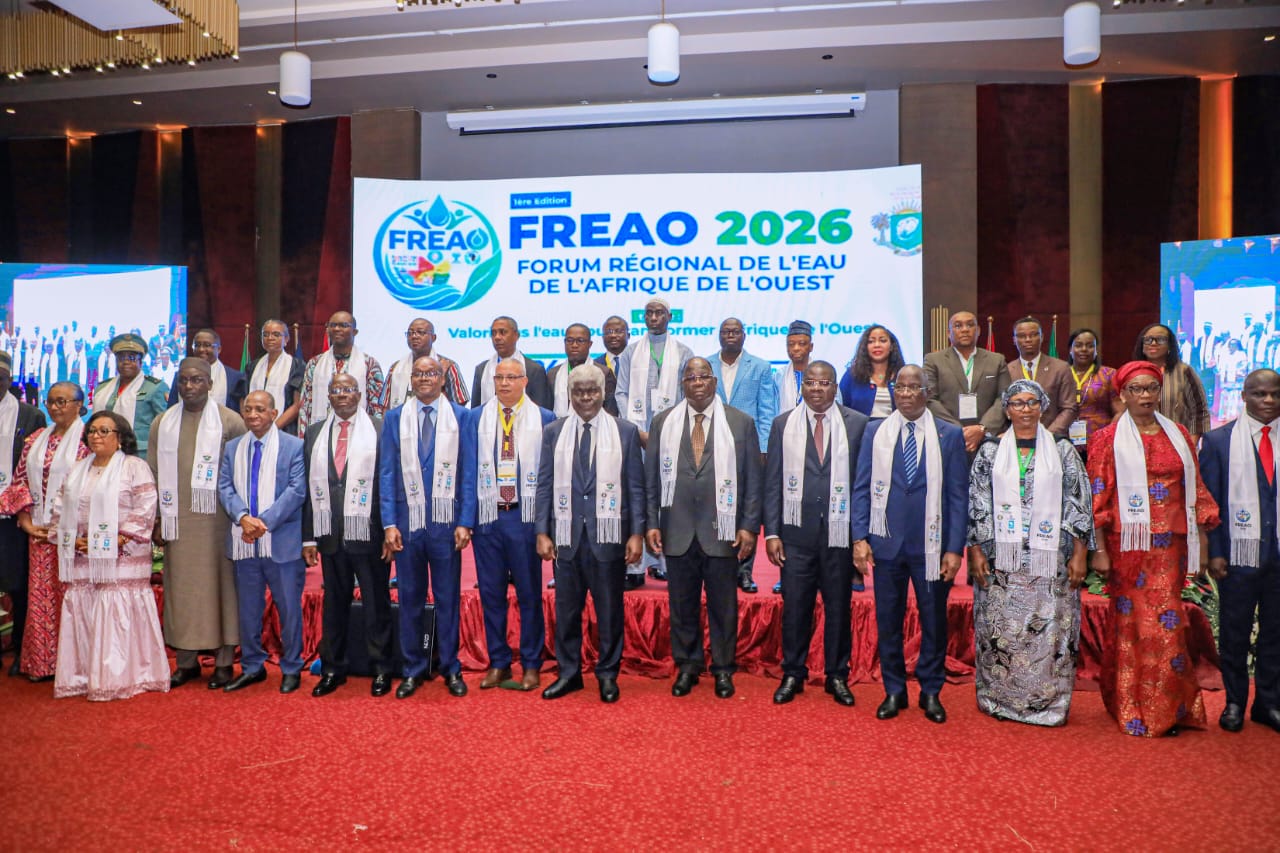
It is in this very spirit that the theme of gender, youth, and social inclusion has been accorded a central and strategic place on the agenda of the First Edition of the West Africa Regional Water Forum (FREAO), to be convened in September 2026 in Abidjan, Côte d’Ivoire, under the theme: “Valuing Water to Transform West Africa.”


ECOWAS Water Resources Management Centre

Mr. Kouakou Alexis KOUASSI, Director of the Water Resources Management Centre, will be among our speakers!

Mr. Kouakou Alexis KOUASSI, Director of the Water Resources Management Centre, will be among our speakers!

An intervention you won’t want to miss!

Relocation of WRMC to Conakry: Follow-up Mission and Meeting with the Prime Minister of Guinea

Following the decision taken by the Conference of Heads of State and Government of ECOWAS in June 2025 regarding the relocation of the Water Resources Management Centre (CGRE) to Conakry, an official mission was conducted to the Republic of Guinea to monitor the progress of the development works at the new headquarters.

A High-Level Meeting to Review Progress

During the visit, the delegation was received by the Prime Minister of the Republic of Guinea. The meeting provided an opportunity to assess the overall progress of the relocation process and to review the measures required to accelerate the effective transfer of the Centre to Conakry.

Discussions also focused on the projected timeline for the effective transfer of activities and on the practical arrangements to be finalized in order to ensure a smooth installation within the agreed timeframe.

The Guinean authorities reaffirmed their commitment to actively support ECOWAS in ensuring the operationalization of the CGRE within the stipulated deadlines.

A Multidisciplinary Institutional Mission

The mission comprised:

  • The ECOWAS Resident Representative in Guinea;

  • The Director of Administration and General Services of ECOWAS, Head of Mission;

  • The Acting Director of Information Technology;

  • The Director of CGRE;

  • Technical teams from Administration and General Services.

This multidisciplinary mission reflects the strategic importance of the relocation process at both organizational and technological levels.

Towards Operationalization by the End of Q1 2026

At the conclusion of the mission, a detailed report will be submitted to the Guinean authorities highlighting priority actions requiring urgent attention to ensure the full operationalization of the new CGRE headquarters in Conakry before the end of the first quarter of 2026.

The relocation of CGRE represents a significant milestone in strengthening regional water governance in West Africa, in line with the strategic orientations defined by the ECOWAS Heads of State and Government.

Partnership signing with the African Water and Sanitation Association (AAEA) this Monday, February 9, 2026, in Yaoundé, on the occasion of the 23rd AAEA Congress

Partnership signing with the African Water and Sanitation Association (AAEA) this Monday, February 9, 2026, in Yaoundé, on the occasion of the 23rd AAEA Congress


“Water is a tool for cooperation and stability in West Africa,” Alexis Kouassi

During a panel focused on strengthening water security, peace, and development through cross-border collaboration, Mr. Alexis Kouassi, Director of the ECOWAS Water Resources Management Center, emphasized the strategic importance of water diplomacy in a region deeply interconnected by shared river basins.

Hosted by UNOWAS alongside the High-Level Preparatory Meeting for the United Nations Water Conference, the session provided a key platform to explore the relationship between joint water governance, conflict prevention, and regional integration. The discussion was moderated by Ms. Tanya Merceron, Climate and Security Adviser.

Mr. Kouassi noted that West Africa stands as a prime example of transboundary water cooperation, hosting almost a quarter of Africa’s shared river basins. Over the years, the region has built a robust institutional framework that promotes coordinated and sustainable management of these vital resources.

The panel gathered representatives from six major basin organizations — including OMVS, NBA, VBA, OMVG, LCBC, and the Mano River Union — who shared experiences, achievements, and challenges in shared water governance across their respective regions.

He stressed that every West African country shares at least one water basin with a neighboring state, making collective governance mechanisms essential to preventing water-related tensions, strengthening community resilience, and supporting regional development.

Aligned with global standards such as the 1992 UN Water Convention, West African states — with the support of ECOWAS — have progressively established transboundary water institutions. This coordinated approach now forms a cornerstone of regional stability and integration.

This dialogue feeds into preparations for the United Nations Water Conference. In this context, ECOWAS is organizing the West Africa Regional Water Forum, scheduled for 21–26 September 2026 in Abidjan, in collaboration with UEMOA and CILSS.
The Forum aims to shape a unified regional advocacy agenda ahead of the global conference in Abu Dhabi.

Key themes will include water diplomacy, conflict prevention, water security, and the role of water in economic and social transformation. The Forum’s theme — “Water to Transform West Africa” — reflects the region’s ambition to position water as a driver of peace, stability, and sustainable development.