
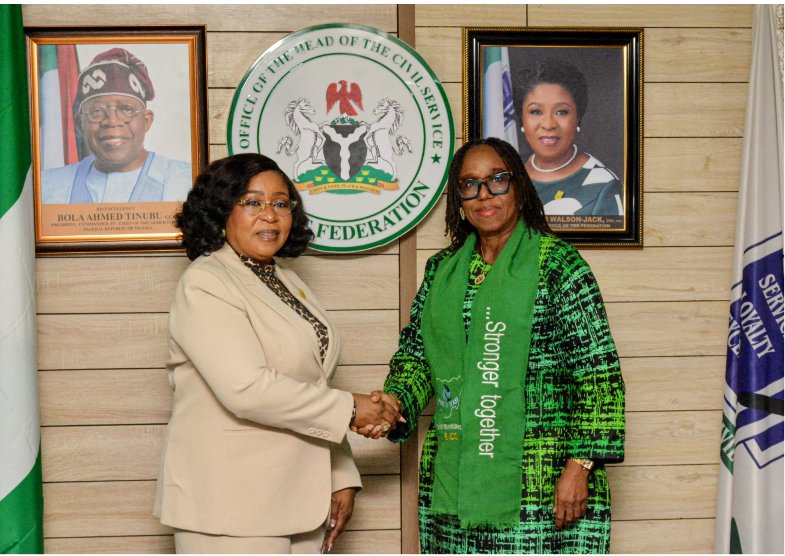
PHOTO NEWS: Head of the Civil Service of the Federation, Mrs. Didi Esther Walson-Jack @Unknown user, OON, mni, today, received the President and Convener of the Network of Female Professionals Working in the WASH Sector (FEMinWASH), Dr. Boluwaji Onabolu, and members of her delegation during a scheduled meeting in her office in Abuja.

FREETOWN, Sierra Leone, 23 June 2026 - Minister of Water Resources and Sanitation, Dr Sao-Kpato Hannah Isatta Macarthy, has pledged to deepen regional cooperation on transboundary water management, strengthen women’s participation in the sector and advance initiatives to protect Sierra Leone’s water resources from the growing impacts of artisanal mining.
During a meeting with Dr Boluwaji Onabolu, the Chairperson of the Regional Consultative Council on Integrated Water Resources Management of ECOWAS, the Minister welcomed proposals for closer collaboration under the ECOWAS water governance framework, noting that Sierra Leone must utilize its leadership role in the region to drive meaningful change.
“We cannot allow the tenure to pass without doing something impactful to show Sierra Leone’s leadership in the water sector,” the Minister said, while endorsing plans to develop a joint project with Liberia and Guinea for the protection and conservation of shared water resources within the Mano River Union basin.
She stressed that the initiative could unlock economic opportunities while preventing potential conflicts over shared water bodies, adding, “There is a lot of potential for economic activity, but at the same time, those waters also have the potential to create conflict. If we are able to develop a joint project among our three countries, it will strengthen protection and conservation of our water boundaries.”
The meeting also focused on empowering women in the water sector and addressing the environmental consequences of artisanal mining. The RCC Chair proposed the establishment of a national network of female professionals in water resources and WASH, arguing that “we are stronger together” and that such a platform would create opportunities for mentorship, technical collaboration and leadership development.
Responding enthusiastically, the Minister, Dr Sao-Kpato Hannah Isatta Macarthy, said, “This female professionals network is really good. If we had a network right now, we would know where these women are and be able to mobilize them. For me, this is a very good initiative that I want to learn more about and support.”
Discussions further explored the impact of artisanal mining on rivers and water quality across Sierra Leone and the wider West African region. The RCC Chair called for a collaborative approach centred on awareness raising, capacity building and water resource protection, stating that “rather than approaching artisanal miners only with enforcement measures, we must also look at protecting water resources while supporting livelihoods.”
The Minister agreed, noting that pollution of major rivers remained a growing concern and revealing plans to work through the National Water Regulatory Agency and development partners to strengthen water quality monitoring and testing.

Side meeting as Chair of the ECOWAS RCC on IWRM with the UN Secretary General's Special Envoy on Water, Her Excellency Ms. Retno Marsudi
This week in Dakar, I spent three intense and energizing days at the heart of the global water diplomacy process first at a one-day stakeholder consultation, followed by a two-day High-Level Preparatory Meeting toward the 2026 UN Water Conference, which Senegal will co-host with United Arabs Emirates in December this year. The meetings were not just about framing another global conference; they were about answering a harder question: how do we move from commitments to delivery, especially in regions facing the sharpest water shaped challenges?
The discussions converged around the six thematic pillars shaping the 2026 Conference: water for people, prosperity, planet, cooperation, multilateral processes, and investment. Across sessions, a clear message emerged, water can no longer be treated as a standalone sector. It must be anchored in health, food systems, energy, climate resilience, peace, in a framework of gender, digital and economic transformation, with strong institutions to carry commitments beyond conference cycles.
The diversity of participants reflected this systems approach: governments, UN agencies, river basin organizations, civil society, women and youth leaders, private sector actors, academia and multilateral development banks. What was particularly encouraging was the growing recognition of regional platforms as essential bridges between global ambition and country-level action.
In my capacity as Chairperson of the ECOWAS Regional Consultative Council on Integrated Water Resources Management (RCC), I had the privilege of representing West Africa, working in close partnership with the ECOWAS Water Resources Management Centre (WRMC) and its Director, Mr Alexis Kouassi.
Together, we articulated a clear regional value proposition: The RCC as ECOWAS’ current highest multi-stakeholder advisory and accountability body on IWRM, and the WRMC as the operational and technical organ on Water. This combination of policy advice, multi-stakeholder accountability, and operational delivery with member states is precisely what the global water agenda has been missing.
My high-level engagements included discussions with the UN Secretary-General’s Special Envoy on Water, Ms Retno L. Mashudi where we aligned strongly on the need to institutionalize accountability, elevate gender and dignity and strengthen transboundary cooperation as a peace and climate strategy.
I and Mr. Alexis Kouassi also engaged with the Secretary of UN-Water’s partnership architecture Ms Madhushree Chattergee who stood in for the Head of the UN Delegation, Mr. Li Junhua, Under Secretary General of UNDESA reinforcing the role regional bodies must play in post-2026 follow-up, in systematic capacity building, enhancing digital literacy, sharing good practices and facilitating the required two way engagement to ensure that the voices of the women and youth of West Africa are heard and their recommendations incorporated in the build up to the UN Water Conference 2026 and beyond. We submitted the position paper and mutually beneficial asks for our member states in ECOWAS.

The Chairperson ECOWAS RCC (Dr Boluwaji Onabolu) and Director ECOWAS WRMC (Mr. Alexis Kouassi) hand over position paper to Ms. Madhushre Chattergee Representing the Under Secretary General of UNDESA Mr. Li Junhua
Equally important were my conversations with key staff of multilateral development banks, where the focus shifted to closing West Africa’s water investment gap through bankable, nexus-based projects, blended finance, and digital transparency. The message was clear: sustainable finance follows institutions, and credible regional platforms reduce risk, build trust, and improve investability. Not less important was the engagement with parliamentarians in the AU/African Renaissance convening on the urgently needed gender transformation of WASH and Water Resources Management without which the aspirations of the SDG 6 and many other SDGs will not be achieved.
My message was clear during the formal and informal meetings alike, West Africa brings both urgency and solutions to the global table from managing over 20 transboundary basins, to community-driven resilience, to tested cooperation models like the Senegal and Niger river basins. The next step is clear: institutionalise delivery. This includes establishing a regional Body of Eminent Persons on Water in collaboration with ECOWAS, strengthening civil society capacity, and embedding RCC–WRMC mechanisms within the 2026 Conference planning and follow-up architecture.
Dakar reminded us that conferences matter, but institutions matter more. West Africa is ready not just to speak, but to deliver.
Dakar reminded us that while conferences matter, people matter more. Scaling up and speeding up water action in West Africa will only be possible through strong multisectoral cooperation anchored in mandated regional institutions. Through ECOWAS, the Regional Consultative Council (RCC) and the Water Resources Management Centre (WRMC), we have a ready platform to turn commitments into people-centred delivery, where women lead, youth innovate, and communities benefit. As we move toward the 2026 UN Water Conference, we call on governments, UN agencies, multilateral development banks, academia, the private sector, civil society, and communities to partner with us in building solutions that endure beyond conferences. Together, we can move from dialogue to delivery and secure water, dignity, and resilience for West Africa.

Side meeting as Chair of the ECOWAS RCC on IWRM with the UN Secretary General's Special Envoy on Water, Her Excellency Ms. Retno Marsudi
This week in Dakar, I spent three intense and energizing days at the heart of the global water diplomacy process first at a one-day stakeholder consultation, followed by a two-day High-Level Preparatory Meeting toward the 2026 UN Water Conference, which Senegal will co-host with United Arabs Emirates in December this year. The meetings were not just about framing another global conference; they were about answering a harder question: how do we move from commitments to delivery, especially in regions facing the sharpest water shaped challenges?
The discussions converged around the six thematic pillars shaping the 2026 Conference: water for people, prosperity, planet, cooperation, multilateral processes, and investment. Across sessions, a clear message emerged, water can no longer be treated as a standalone sector. It must be anchored in health, food systems, energy, climate resilience, peace, in a framework of gender, digital and economic transformation, with strong institutions to carry commitments beyond conference cycles.
The diversity of participants reflected this systems approach: governments, UN agencies, river basin organizations, civil society, women and youth leaders, private sector actors, academia and multilateral development banks. What was particularly encouraging was the growing recognition of regional platforms as essential bridges between global ambition and country-level action.
In my capacity as Chairperson of the ECOWAS Regional Consultative Council on Integrated Water Resources Management (RCC), I had the privilege of representing West Africa, working in close partnership with the ECOWAS Water Resources Management Centre (WRMC) and its Director, Mr Alexis Kouassi.
Together, we articulated a clear regional value proposition: The RCC as ECOWAS’ current highest multi-stakeholder advisory and accountability body on IWRM, and the WRMC as the operational and technical organ on Water. This combination of policy advice, multi-stakeholder accountability, and operational delivery with member states is precisely what the global water agenda has been missing.
My high-level engagements included discussions with the UN Secretary-General’s Special Envoy on Water, Ms Retno L. Mashudi where we aligned strongly on the need to institutionalize accountability, elevate gender and dignity and strengthen transboundary cooperation as a peace and climate strategy.
I and Mr. Alexis Kouassi also engaged with the Secretary of UN-Water’s partnership architecture Ms Madhushree Chattergee who stood in for the Head of the UN Delegation, Mr. Li Junhua, Under Secretary General of UNDESA reinforcing the role regional bodies must play in post-2026 follow-up, in systematic capacity building, enhancing digital literacy, sharing good practices and facilitating the required two way engagement to ensure that the voices of the women and youth of West Africa are heard and their recommendations incorporated in the build up to the UN Water Conference 2026 and beyond. We submitted the position paper and mutually beneficial asks for our member states in ECOWAS.
The Chairperson ECOWAS RCC (Dr Boluwaji Onabolu) and Director ECOWAS WRMC (Mr. Alexis Kouassi) hand over position paper to Ms. Madhushre Chattergee Representing the Under Secretary General of UNDESA Mr. Li Junhua
Equally important were my conversations with key staff of multilateral development banks, where the focus shifted to closing West Africa’s water investment gap through bankable, nexus-based projects, blended finance, and digital transparency. The message was clear: sustainable finance follows institutions, and credible regional platforms reduce risk, build trust, and improve investability. Not less important was the engagement with parliamentarians in the AU/African Renaissance convening on the urgently needed gender transformation of WASH and Water Resources Management without which the aspirations of the SDG 6 and many other SDGs will not be achieved.
My message was clear during the formal and informal meetings alike, West Africa brings both urgency and solutions to the global table from managing over 20 transboundary basins, to community-driven resilience, to tested cooperation models like the Senegal and Niger river basins. The next step is clear: institutionalise delivery. This includes establishing a regional Body of Eminent Persons on Water in collaboration with ECOWAS, strengthening civil society capacity, and embedding RCC–WRMC mechanisms within the 2026 Conference planning and follow-up architecture.
Dakar reminded us that conferences matter, but institutions matter more. West Africa is ready not just to speak, but to deliver.
Dakar reminded us that while conferences matter, people matter more. Scaling up and speeding up water action in West Africa will only be possible through strong multisectoral cooperation anchored in mandated regional institutions. Through ECOWAS, the Regional Consultative Council (RCC) and the Water Resources Management Centre (WRMC), we have a ready platform to turn commitments into people-centred delivery, where women lead, youth innovate, and communities benefit. As we move toward the 2026 UN Water Conference, we call on governments, UN agencies, multilateral development banks, academia, the private sector, civil society, and communities to partner with us in building solutions that endure beyond conferences. Together, we can move from dialogue to delivery and secure water, dignity, and resilience for West Africa.

Dakar, July 11, 2025
ECOWAS Relaunches the Sub-Regional Consultative Council on Water Resources (CRCRE) in Dakar
On July 10–11, 2025, Dakar hosted the 1st Extraordinary Session of the Sub-Regional Consultative Council on Water Resources (CRCRE) of the Permanent Framework for Coordination and Monitoring (CPCS) of Integrated Water Resources Management (IWRM) in West Africa. This meeting marked the official relaunch of the CRCRE, after several years of interruption, with the aim of strengthening regional cooperation around water-related issues.
The session, chaired by Mr. Baboucar Mboundar NGOM, Secretary-General of the Ministry of Water and Sanitation of Senegal, brought together IWRM focal points from ECOWAS and UEMOA Member States, representatives of river basin organizations, local authorities, civil society organizations, technical and financial partners, as well as sub-regional institutions.
Participants discussed ongoing regional initiatives, including the ECOWAS Special Drinking Water Supply Project, the West Africa Regional Water Forum (FREAO), preparations for the United Nations Water Conference 2026, as well as innovative programs for youth mobilization and capacity building in the water sector.
A key highlight of the session was the unanimous election of Dr. Boluwaji Onabolu, President of FEMinWASH (Nigeria), as Chair of the CRCRE for a two-year term. In her address, she expressed her gratitude and called for collective commitment to revitalize the Council and promote participatory water governance.
The deliberations also examined ways to strengthen the involvement of civil society organizations in the regional IWRM process, with a particular focus on youth, gender, cross-border cooperation, and the sustainability of actions.
The closing ceremony, chaired by Dr. Bakary FATY, representing the Minister of Water and Sanitation of Senegal, praised the quality of the exchanges and reaffirmed the commitment of regional stakeholders to work together to address water-related challenges in West Africa.